

featured
Foundation and Board Exam Prep
Muscular System: Functions, Types, and Key Muscles in the Human Body
Edited by:Aakash Digital
10 min read • Updated on Aug 05 2026, 01:21 PM IST
featured
Muscular System: Functions, Types, and Key Muscles in the Human Body
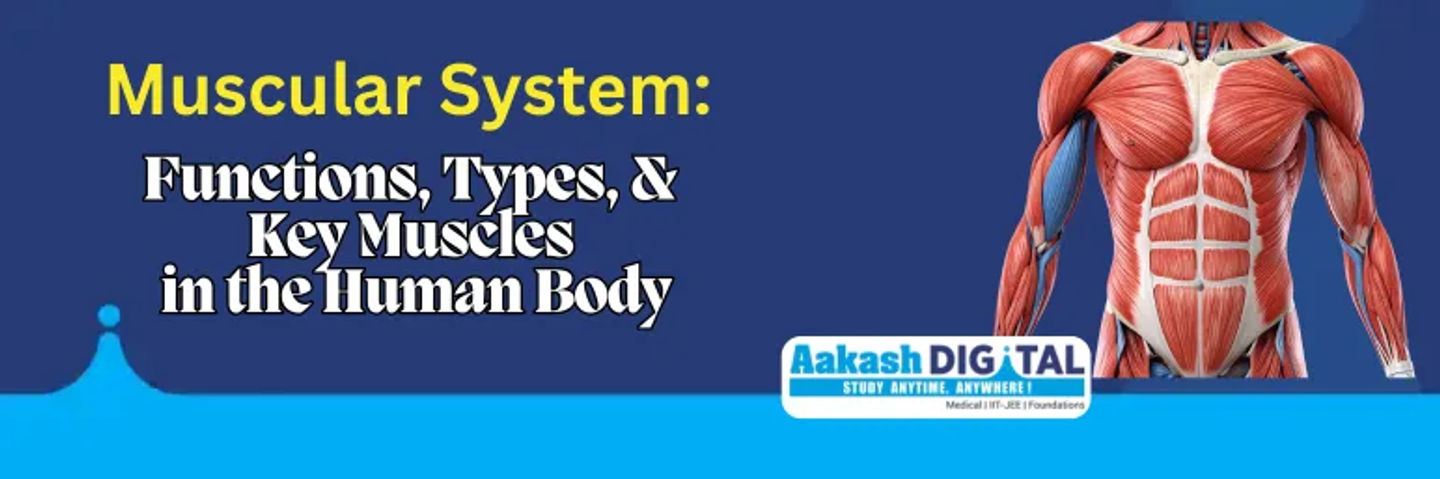
The muscular system is one of the most important systems in our body. It's made up of more than 600 muscles, all working together to help us move, stay balanced, and perform many vital tasks that keep us alive.
Overview of the Human Muscular System
The muscular system is one of the most important systems in our body. It’s made up of more than 600 muscles, all working together to help us move, stay balanced, and perform many vital tasks that keep us alive. Muscles are the tissues that allow us to do everything from walking and talking to breathing and pumping blood.
Each muscle has a specific job. For example, some muscles are responsible for moving our arms and legs, while others help us smile or chew our food. There are also muscles we don’t control consciously, like the heart muscle that pumps blood throughout our body, and the muscles in our stomach that help digest food.
The muscular system is essential not just for movement, but also for other functions that are crucial for our survival. It helps us maintain our posture, so we can stand up straight, and it generates heat, which keeps our body warm. Muscles also play a role in circulating blood and other fluids around the body, ensuring that our organs get the oxygen and nutrients they need to function properly.
Understanding the muscular system means looking at the different types of muscles, how they work, and why they are important. This blog talks about learning about some of the key muscles in our body that we use every day, often without even thinking about it.
What is the Muscular System?
The muscular system is a network of muscles in our body that helps us move, stay balanced, and perform essential tasks like breathing and pumping blood. It includes over 600 muscles, each with its own job. Some muscles are under our control, like those we use to walk or lift things, while others work automatically, like the heart muscle. This system is crucial for our everyday activities and overall health, as it supports movement, posture, and vital functions that keep us alive.
In addition to movement, the muscular system also plays a key role in maintaining our posture and body shape. It helps us stay upright, whether we are sitting, standing, or walking. Muscles also generate heat as they work, which helps keep our body temperature stable. Without the muscular system, we wouldn’t be able to perform simple tasks like holding a pencil, blinking, or even smiling. It’s a complex and essential part of our body that works constantly, often without us even realizing it.
Types of Muscles in the Human Body
The human body has three main types of muscles: skeletal muscles, cardiac muscles, and smooth muscles. Each type has a unique function and structure, contributing to different bodily processes.
Skeletal Muscles in the Human Body: Structure and Functions
Skeletal muscles are the muscles we can control voluntarily. These muscles are attached to our bones by tendons, and they are responsible for movements like walking, running, and lifting objects.
When you decide to move a part of your body, your brain sends signals to the skeletal muscles, causing them to contract and pull on the bones, creating movement. Skeletal muscles also help maintain posture and stabilize joints. They appear striped, or striated, under a microscope.
What Are Cardiac Muscles?
Cardiac muscles are found only in the heart. These muscles work involuntarily, meaning we don’t have to think about making them move. Their main job is to pump blood throughout the body by contracting in a coordinated way.
The unique structure of cardiac muscles allows them to be strong and durable, enduring a lifetime of constant activity. Like skeletal muscles, cardiac muscles are also striated, but they are specifically designed to never tire, keeping the heart beating continuously.
What Are Smooth Muscles? Structure, Functions, and Location
Smooth muscles are found in the walls of internal organs such as the stomach, intestines, blood vessels, and bladder. These muscles also work involuntarily, controlling movements like the digestion of food and the regulation of blood flow.
Unlike skeletal and cardiac muscles, smooth muscles do not have a striated appearance; instead, they look smooth under a microscope. Smooth muscles contract in a slower, more sustained way, which is ideal for controlling long-lasting processes in the body, like moving food through the digestive system or controlling the diameter of blood vessels.
Anatomy of Skeletal Muscles
Skeletal muscles are the muscles that we can consciously control. They are connected to our bones and play a crucial role in movement and maintaining posture. Each skeletal muscle is made up of bundles of muscle fibers, which are long, thin cells that can contract when stimulated by nerves.
These muscles work by pulling on bones, which allows us to perform a wide range of motions, from walking and running to lifting and throwing. Understanding the anatomy of skeletal muscles helps us appreciate how these muscles function and how they are organized in the body.
Major Skeletal Muscles and Their Functions
| Muscle | Location | Function |
| Biceps Brachii | Front of upper arm | Flexes the elbow and rotates the forearm |
| Triceps Brachii | Back of upper arm | Extends the elbow, straightening the arm |
| Deltoid | Shoulder | Lifts the arm away from the body |
| Pectoralis Major | Chest | Moves the arm across the chest, helps in pushing movements |
| Quadriceps | Front of thigh | Extends the knee, essential for walking, running, and jumping |
| Hamstrings | Back of thigh | Flexes the knee, important for bending the leg |
| Gluteus Maximus | Buttocks | Extends the hip, crucial for standing up and climbing stairs |
| Gastrocnemius | Calf | Flexes the foot, helps in pushing off while walking or running |
| Latissimus Dorsi | Back | Moves the shoulder and arm, particularly in pulling actions |
Muscle Groups and Their Roles
| Muscle Group | Key Muscles | Role |
| Upper Body | Biceps, Triceps, Deltoids, Pectoralis Major | Enables arm and shoulder movements, pushing, and pulling |
| Core | Rectus Abdominis, Obliques, Erector Spinae | Supports posture, stabilizes the body, and aids in bending and twisting |
| Lower Body | Quadriceps, Hamstrings, Gluteus Maximus, Gastrocnemius | Supports walking, running, jumping, and balance |
| Back | Latissimus Dorsi, Trapezius, Rhomboids | Allows pulling movements, supports posture, and stabilizes the spine |
Functions of the Muscular System
The muscular system is essential for many of the body’s basic functions. It is responsible for movement, allowing us to perform everyday activities like walking, running, and lifting objects.
Beyond movement, muscles also help maintain posture, stabilize joints, and even generate heat to keep our body warm. Understanding the functions of the muscular system helps us appreciate how muscles contribute to our overall health and well-being.
1. What Is Movement and Locomotion in the Human Body?
| Function | Description | Examples |
| Voluntary Movement | Muscles contract and relax to move body parts at will | Walking, lifting, running |
| Locomotion | Muscles work with bones to enable movement from one place to another | Running, jumping, swimming |
| Fine Motor Skills | Precise muscle movements for detailed tasks | Writing, typing, picking up small objects |
2. Posture and Stability: Functions and Importance
| Function | Description | Examples |
| Posture Maintenance | Muscles keep the body upright and aligned | Standing, sitting straight |
| Joint Stability | Muscles support and stabilize joints to prevent injury | Holding a position, preventing falls |
| Balance | Muscles work together to maintain equilibrium | Balancing on one foot, walking on uneven surfaces |
3. What Is Heat Production in the Muscular System?
| Function | Description | Examples |
| Thermogenesis | Muscles generate heat during contraction to maintain body temperature | Shivering, exercising in cold weather |
| Heat Distribution | Muscle-generated heat spreads through the body, helping to keep it warm | Warmth after physical activity |
| Increased Metabolism | Muscle activity boosts metabolism, leading to more heat production | Sweating during intense exercise |
4. How Muscles Help in Blood Circulation?
| Function | Description | Examples |
| Heart Contraction | Cardiac muscles in the heart pump blood throughout the body | Blood circulation from the heart to the organs |
| Venous Return | Skeletal muscles help push blood back to the heart through veins | Muscle contractions during walking or exercise |
| Blood Vessel Regulation | Smooth muscles in blood vessels contract or relax to regulate blood flow | Adjusting blood flow during exercise or rest |
5. Muscles Involved in Respiration: Functions and Importance
| Function | Description | Examples |
| Breathing | The diaphragm and intercostal muscles contract and relax to enable breathing | Inhaling and exhaling |
| Airflow Regulation | Muscles adjust the size of airways to control airflow into and out of the lungs | Deep breathing, coughing |
| Oxygen Supply | Muscle contractions ensure a continuous supply of oxygen to the body | Increased breathing rate during exercise |
6. Digestion and Waste Removal
| Function | Description | Examples |
| Peristalsis | Smooth muscles in the digestive tract contract rhythmically to move food through the system | Moving food from the esophagus to the stomach |
| Waste Elimination | Muscles in the intestines and bladder help in the expulsion of waste | Bowel movements, urination |
| Nutrient Absorption | Muscle contractions aid in breaking down food and moving it through the digestive system for nutrient absorption | Digestion of food in the stomach and intestines |
7. Protection of Internal Organs
| Function | Description | Examples |
| Physical Barrier | Muscles in the torso and abdomen protect vital organs from injury | Abdominal muscles shielding the intestines |
| Shock Absorption | Muscles help absorb impacts, reducing damage to internal organs | Muscles around the ribs cushioning the heart and lungs |
| Support for Internal Organs | Muscles help keep organs in place, preventing them from shifting | Pelvic floor muscles supporting the bladder and intestines |
What is Muscle Contraction?
Muscle contraction is the process by which muscles become shorter and tighter, allowing them to produce movement or maintain tension. This process is essential for everything we do, from simple actions like picking up a cup to complex movements like running or jumping.
When a muscle contracts, it pulls on the bones it’s attached to, creating motion. Muscle contraction also plays a role in maintaining posture, stabilizing joints, and generating force. Understanding how muscle contraction works helps us appreciate how our body performs everyday activities and how we can control and strengthen our muscles.
How Do Muscles Contract?
The Sliding Filament Theory is a widely accepted explanation of how muscles contract at a microscopic level. According to this theory, muscle contraction occurs when the thin filaments (actin) and thick filaments (myosin) within muscle fibers slide past each other. This sliding action shortens the overall length of the muscle fiber, causing the muscle to contract.
Here’s how it works in simple terms:
The Sliding Filament Theory is crucial for understanding how muscles produce force and movement. It highlights the coordinated actions that occur within our muscles every time we move.
Types of Muscle Contractions: Isometric vs. Isotonic
Isometric Contractions:
Isometric contractions occur when the muscle generates force without changing its length. In other words, the muscle is engaged, but there is no visible movement of the body part. This type of contraction is important for maintaining posture and stabilizing joints.
Key Features of Isometric Contractions:
Isotonic Contractions:
Isotonic contractions involve the muscle changing its length while generating force.
Key Features of Isotonic Contractions:
Common Muscle Disorders and Injuries
Muscle disorders and injuries can affect how our muscles work and move. They can cause pain, weakness, and limited movement, impacting daily activities and overall quality of life.
Quick Revision: Muscular System at a Glance
Before your exam, revise these key points to quickly refresh the entire chapter.
| Topic | Key Point to Remember |
| What is the muscular system? | A body system made up of more than 600 muscles that helps with movement, posture, breathing, blood circulation, and other vital functions. |
| Types of muscles | There are three types: Skeletal, Cardiac, and Smooth muscles. |
| Skeletal muscles | Voluntary muscles attached to bones. They help us walk, run, write, and perform all conscious body movements. |
| Cardiac muscles | Found only in the heart. They contract involuntarily to pump blood throughout the body. |
| Smooth muscles | Present in internal organs like the stomach, intestines, bladder, and blood vessels. They control involuntary movements such as digestion and blood flow. |
| Main functions | Movement, posture, joint stability, heat production, breathing, blood circulation, and digestion are the major functions of the muscular system. |
| Muscle contraction | Muscles contract when actin and myosin filaments slide past each other in the Sliding Filament Theory, producing force and movement. |
| Types of contraction | Isometric: Muscle length stays the same. Isotonic: Muscle length changes to produce movement. |
| Exam tip | Remember: Skeleton = Skeletal, Heart = Cardiac, Internal Organs = Smooth. This simple association helps answer many MCQs correctly. |
Q1. What is the main function of the muscular system?
The main function of the muscular system is to enable movement. Muscles contract and pull on bones, allowing us to perform various actions like walking, lifting, and even facial expressions. Additionally, muscles help maintain posture, stabilize joints, and generate heat.
Q2. How many types of muscles are there in the human body?
There are three main types of muscles in the human body:
Q3. What are the differences between isometric and isotonic muscle contractions?
Isometric contractions occur when muscles generate force without changing length. Isotonic contractions involve muscle length changing during movement.
Q4. What is the Sliding Filament Theory of muscle contraction?
The Sliding Filament Theory explains how actin and myosin filaments slide past each other, shortening muscle fibres and producing movement.
Q5. What are common muscle disorders and injuries?
Common muscle disorders and injuries include strains, sprains, muscle cramps, tendinitis, bursitis, fibromyalgia, myositis, muscular dystrophy, rhabdomyolysis, and shin splints.
Sign in to create an account for tailored recommendations based on your interest and preference

 Access free videos worth ₹5000Explore core concept videosClear all your doubts
 Access free videos worth ₹5000Explore core concept videosClear all your doubts